A Practical Guide to Recycle E-Waste Properly in Singapore<\h1>
Quick stat: Singapore has over 300 e-waste drop-off points recover gold each year—enough for about 18,000 wedding rings? That impressive number highlights the hidden value inside retired devices and the urgent need for responsible disposal. As tech lifecycles shorten, e-waste management has shifted from a choice<\em> to a necessity<\span><\em> for protecting the environment.<\p>
Singapore’s government created a streamlined system that blends public drop-off bins, quarterly drives, and certified handlers such as Advance Recycling. These channels keep toxins out of landfills and recover metals such as palladium and copper. Every properly Advance Recycling – ewaste recycle processed smartphone or laptop avoids contamination of groundwater and soil.<\p>
This guide explains how to navigate Singapore’s e-waste ecosystem confidently. You’ll learn to identify recyclable items, wipe personal data securely, and choose between neighborhood bins or scheduled pickups. Discover how professional services simplify compliance with local regulations while supporting the nation’s sustainability goals.<\p>
Key Takeaways<\h3>
- Singapore offers more than 300 e-waste drop-off locations<\li>
- National regulations ensure safe extraction of valuable materials<\li>
- Retired gadgets include recoverable high-value metals<\li>
- Doorstep collection is available via certified handlers<\li>
- Responsible disposal reduces pollution risks<\li>
<\ul>
Introduction to Electronic Recycling in Singapore<\h2>
From smartphones to refrigerators, discarded tech forms Singapore’s fastest-growing waste stream. They pack valuable materials and risks that need expert handling. Right methods safeguard health and nature and recover valuable materials.<\p>
E-Waste Explained<\h3>
E-waste is any electrical or electronic device that’s no longer in use. Examples include laptops, printers, and air conditioners. Many contain valuable metals – a single washing machine holds enough copper to make 40 power cables.<\p>
However, these devices also carry risks. Improper dumping can leach lead and mercury into groundwater. Certified processors such as Advance Recycling apply advanced techniques to separate reusable materials from hazardous parts.<\p>
Benefits of Proper Electronic Disposal<\h3>
Responsible handling keeps toxins out of landfills. It also recovers rare metals for new products, reducing mining needs. Per tonne of e-waste processed, typical savings include:<\p>
- about 17 tonnes of virgin extraction avoided<\li>
- roughly 3,000 liters of water at risk of contamination<\li>
- approximately 400 kg of GHG emissions<\li>
<\ul>
Advance Recycling supports Singapore’s efforts with secure data wiping and advanced recovery. They aim for ~98% of components to be reused or neutralized safely. This method supports ecological balance and economic efficiency.<\p>
Understanding E-Waste Regulations in Singapore<\h2>
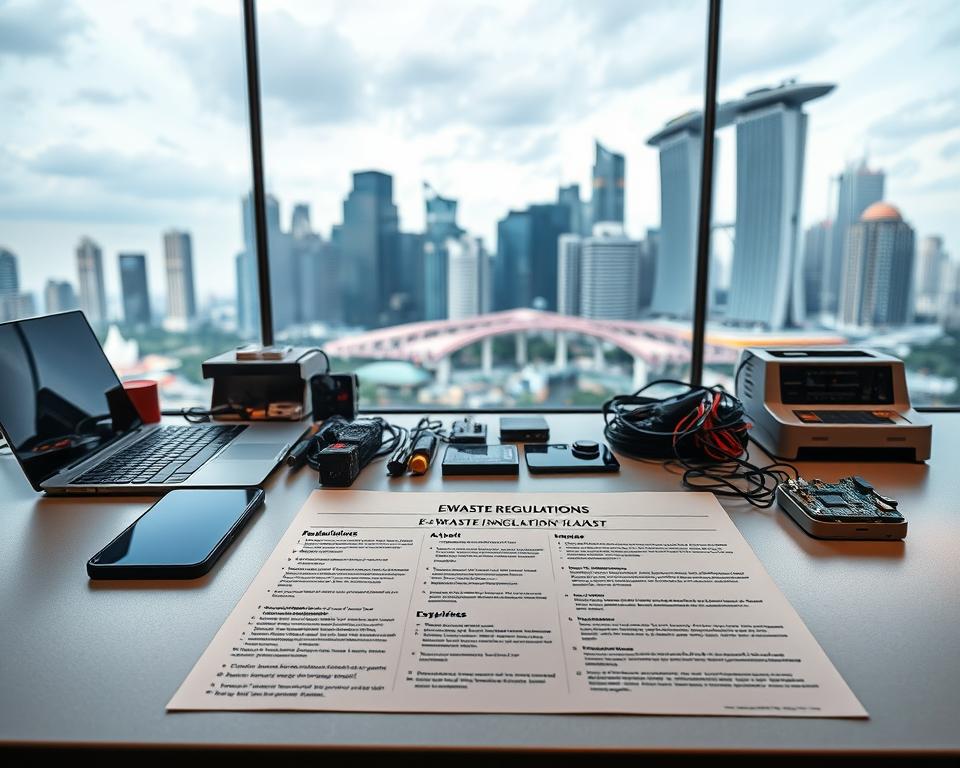
Singapore’s e-waste management system operates under precise legal frameworks designed to balance convenience and environmental safety. From July 2021, NEA mandates retailer take-back when customers purchase new items, cross-brand included. This 1-for-1 rule applies to categories such as printers, lamps, and ICT equipment.<\p>
The NEA authorizes specific collection channels to streamline disposal. E-bins accept small items and batteries; bulky devices go via scheduled collection. There are 800+ islandwide locations accepting regulated waste for easy access.<\p>
Licensed processors such as Advance Recycling adhere to strict protocols. They apply NEA-approved techniques for recovery and neutralization. Each step, from wiping to extraction, is audit-documented for transparency.<\p>
Key aspects of the regulatory framework include:<\p>
- Mandatory retailer participation in take-back programs<\li>
- Clear categorization of devices into consumer, commercial, and industrial classes<\li>
- Real-time tracking of waste flows from collection to processing<\li>
<\ul>
They curb illegal dumping and enable repurposing of up to 90% of components. Alignment with standards like the Basel Convention keeps Singapore a regional leader.<\p>
The Advance Recycling Advantage: Expertise and Sustainability<\h2>
Singapore’s battle against tech waste requires partners who combine technical mastery with environmental vision. Leading the way is a team reshaping end-of-life handling with intelligent recovery.<\p>
Company Profile and Commitment<\h3>
Advance Recycling has pioneered closed-loop tech-material systems since 2010. A 12,000-sq-ft facility processes 8+ tonnes per day with IR scanners and electrostatic separators. This technology identifies reusable components<\em> with ~99.8% accuracy—vital for high recovery.<\p>
The team specializes in secure data destruction and chemical neutralization. Certified specialists dismantle devices using methods that preserve 94% of precious metals. This precision working<\em> process meets Singapore’s strict safety standards while recovering resources for manufacturing.<\p>
Notable innovations include:<\p>
- Mobile shredders for on-premise corporate collections<\li>
- Blockchain-tracked material flows<\li>
- Artificial-intelligence sorting solutions<\li>
<\ul>
These solutions<\em> help businesses achieve zero-waste targets and households contribute to national sustainability<\span><\em> goals. By transforming discarded gadgets into raw materials, Advance Recycling closes the loop in Singapore’s circular economy.<\p>
How to Recycle Electronics Safely in Singapore<\h2>
Over 60,000 tonnes of tech waste are discarded yearly; proper handling turns it into resources. Whether dealing with one phone or a full office refresh, Singapore provides solutions that protect ecosystems and sensitive data.<\p>
Begin by sorting by size and device type. Take out batteries; they need designated handling. For data-bearing items:<\p>
- Use certified data-wiping tools<\li>
- Physically destroy drives if uncertain<\li>
- Keep chargers and cables separate<\li>
<\ul>
Public bins accept smaller items like phones and tablets. Confirm your device fits; standard slots are about 50 cm wide. Bigger items need other channels.<\p>
Professional Pickup Services<\h3>
Advance Recycling streamlines bulk disposal via scheduled pickups. Specialists handle:<\p>
- Documentation issued the same day<\li>
- On-site secure data destruction<\li>
- Proper classification of hazardous materials<\li>
<\ul>
These services are vital for office refreshes and multi-appliance changes. Unlike bins, items of any size are accepted with full compliance.<\p>
Common E-Waste Categories in Singapore<\h2>
Households and businesses discard 150+ tech device types annually. These range from palm-sized gadgets to refrigerator-sized units, each needing specific handling. Proper sorting ensures maximum material recovery and regulatory compliance.<\p>
Small Appliances and Entertainment Gear<\h3>
Compact appliances are prominent in the waste stream. Kitchen tools like microwaves and air fryers mix metals with heat-resistant plastics. Personal care items (straighteners, electric toothbrushes) include copper wiring and lithium batteries.<\p>
Class<\th>
Sample Items<\th>
Primary Materials<\th>
Processing Method<\th><\tr>
Kitchen Tech<\td>
Blenders, rice cookers<\td>
Glass, stainless steel<\td>
Shred and sort<\td><\tr>
Entertainment Gear<\td>
Speakers, game consoles<\td>
Gold, rare earth metals<\td>
Detailed dismantling<\td><\tr>
Climate Control<\td>
Fans and air purifiers<\td>
Aluminum and copper coils<\td>
Magnetic separation<\td><\tr>
<\tbody>
<\table>
Managing Large Appliances<\h3>
Bulky items like refrigerators require specialized protocols. Teams use climate-controlled trucks to move these appliances<\em> safely. Facilities remove refrigerants and separate steel from insulation.<\p>
Oversized devices account for 38% of recovered metals in Singapore. Professional services ensure toxic components get neutralized while reusable parts re-enter manufacturing cycles. This converts retired equipment into feedstock for new goods.<\p>
Finding Collection Points and Bins<\h2>
Singapore’s disposal network offers multiple pathways for tech items, blending accessibility with environmental responsibility. Specialized containers and community drives simplify participation.<\p>
Public Drop-Off Points<\h3>
There are 466+ green RENEW bins across 418 locations. These bright receptacles appear in supermarkets, parks, and government buildings. Accepted size is 47×12×47 cm, ideal for phones, cables, small kitchen items.<\p>
Method<\th>
Coverage<\th>
Item Size<\th>
Use Case<\th><\tr>
RENEW Bins<\td>
418 locations<\td>
Compact devices<\td>
Everyday drop-offs<\td><\tr>
Estate Drives<\td>
Residential estates<\td>
Mid-sized items<\td>
Neighborhood events<\td><\tr>
Retail Take-Back<\td>
Retail partners<\td>
Small portable tech<\td>
Shopping trips<\td><\tr>
<\tbody>
<\table>
Home & Counter Collection<\h3>
Residential areas hold quarterly drives for outdated devices. Retailers like City Square Mall accept items at service counters, integrating disposal with errands. For telecom gear, M1 partners with Virogreen for drop-offs.<\p>
Apps and sites simplify searching for bins. NEA sites and ALBA’s STEP UP app offer real-time bin maps. They aren’t ideal for large items or secure data tasks.<\p>
For full-service needs, Advance Recycling bridges the gaps. Offerings include:<\p>
- Doorstep removal of oversized items<\li>
- Certified data destruction<\li>
- Full-process documentation<\li>
<\ul>
Health & Environmental Gains from Recycling<\h2>
Beneath retired devices lies opportunity in a tech-driven Singapore. Responsible methods convert hazards into resources, protecting ecosystems and supporting sustainable manufacturing.<\p>
Guarding Resources, Protecting Lives<\h3>
Phones and laptops contain traces of gold, silver, and palladium. Professional processing returns these metals to production. Mishandling can release lead and mercury into groundwater, risking marine life and water supplies.<\p>
Advance Recycling’s working<\em> methods prevent toxic leakage while recovering 97% of reusable components<\span><\em>. Infrared sorting isolates precious materials with high precision. This approach avoids 14kg of mining waste per recycled device.<\p>
Proper treatment also safeguards air<\em> quality by preventing incineration of plastic casings. Facilities neutralize brominated flame retardants tied to respiratory risks. These steps reduce health risks and conserve finite resources.<\p>
FAQ<\h2>
What items qualify as e-waste in Singapore?<\h3>
E-waste includes devices like mobile phones, laptops, printers, microwaves, and home appliances such as vacuums or air conditioners. Batteries, bulbs, and small electronic gadgets are included too.<\p>
<\div><\div><\div>
Do fines apply for improper e-waste disposal?<\h3>
Singapore’s National Environment Agency (NEA) enforces strict guidelines. Improperly discarding regulated items like printers or batteries may result in fines, as these materials require specialized handling to avoid environmental harm.<\p>
<\div><\div><\div>
Can damaged electronics still be recycled?<\h3>
Absolutely. Centers accept damaged or obsolete gear, such as non-functional fans, ovens, and shredders. Technicians safely dismantle components to recover metals and reusables.<\p>
<\div><\div><\div>
How do I dispose of bulky items (e.g., fridges)?<\h3>
Use designated points or schedule a professional pickup for bulky items. Providers such as ALBA E-Waste handle doorstep pickup of large appliances.<\p>
<\div><\div><\div>
How do I use the bins for small items?<\h3>
Use bright bins in community centers, shops, or offices for cables, keyboards, and small gadgets. Check the bin’s label for accepted materials before depositing.<\p>
<\div><\div><\div>
Why separate battery recycling?<\h3>
Batteries include toxic chemicals that may leach into soil and water. Use specialized collection boxes at supermarkets/electronics stores for safe processing and metal recovery.<\p>
<\div><\div><\div>
How is my data handled on recycled devices?<\h3>
Reputable recyclers like StarHub’s RENEW program use certified data-wiping methods. For added security, manually delete personal information before handing over phones, computers, or storage drives.<\p>
<\div><\div><\div>
Any perks for recycling old electronics?<\h3>
Certain retailers provide trade-in discounts or vouchers for old gadgets. Programs like Panasonic’s appliance recycling initiative also promote sustainability through brand-led partnerships.<\p>
<\div><\div><\div><\section>
<\ul>
Introduction to Electronic Recycling in Singapore<\h2>
From smartphones to refrigerators, discarded tech forms Singapore’s fastest-growing waste stream. They pack valuable materials and risks that need expert handling. Right methods safeguard health and nature and recover valuable materials.<\p>
E-Waste Explained<\h3>
E-waste is any electrical or electronic device that’s no longer in use. Examples include laptops, printers, and air conditioners. Many contain valuable metals – a single washing machine holds enough copper to make 40 power cables.<\p>
However, these devices also carry risks. Improper dumping can leach lead and mercury into groundwater. Certified processors such as Advance Recycling apply advanced techniques to separate reusable materials from hazardous parts.<\p>
Benefits of Proper Electronic Disposal<\h3>
Responsible handling keeps toxins out of landfills. It also recovers rare metals for new products, reducing mining needs. Per tonne of e-waste processed, typical savings include:<\p>
- about 17 tonnes of virgin extraction avoided<\li>
- roughly 3,000 liters of water at risk of contamination<\li>
- approximately 400 kg of GHG emissions<\li>
<\ul>Advance Recycling supports Singapore’s efforts with secure data wiping and advanced recovery. They aim for ~98% of components to be reused or neutralized safely. This method supports ecological balance and economic efficiency.<\p>
Understanding E-Waste Regulations in Singapore<\h2>
Singapore’s e-waste management system operates under precise legal frameworks designed to balance convenience and environmental safety. From July 2021, NEA mandates retailer take-back when customers purchase new items, cross-brand included. This 1-for-1 rule applies to categories such as printers, lamps, and ICT equipment.<\p>
The NEA authorizes specific collection channels to streamline disposal. E-bins accept small items and batteries; bulky devices go via scheduled collection. There are 800+ islandwide locations accepting regulated waste for easy access.<\p>
Licensed processors such as Advance Recycling adhere to strict protocols. They apply NEA-approved techniques for recovery and neutralization. Each step, from wiping to extraction, is audit-documented for transparency.<\p>
Key aspects of the regulatory framework include:<\p>
- Mandatory retailer participation in take-back programs<\li>
- Clear categorization of devices into consumer, commercial, and industrial classes<\li>
- Real-time tracking of waste flows from collection to processing<\li>
<\ul>They curb illegal dumping and enable repurposing of up to 90% of components. Alignment with standards like the Basel Convention keeps Singapore a regional leader.<\p>
The Advance Recycling Advantage: Expertise and Sustainability<\h2>
Singapore’s battle against tech waste requires partners who combine technical mastery with environmental vision. Leading the way is a team reshaping end-of-life handling with intelligent recovery.<\p>
Company Profile and Commitment<\h3>
Advance Recycling has pioneered closed-loop tech-material systems since 2010. A 12,000-sq-ft facility processes 8+ tonnes per day with IR scanners and electrostatic separators. This technology identifies reusable components<\em> with ~99.8% accuracy—vital for high recovery.<\p>
The team specializes in secure data destruction and chemical neutralization. Certified specialists dismantle devices using methods that preserve 94% of precious metals. This precision working<\em> process meets Singapore’s strict safety standards while recovering resources for manufacturing.<\p>
Notable innovations include:<\p>
- Mobile shredders for on-premise corporate collections<\li>
- Blockchain-tracked material flows<\li>
- Artificial-intelligence sorting solutions<\li>
<\ul>These solutions<\em> help businesses achieve zero-waste targets and households contribute to national sustainability<\span><\em> goals. By transforming discarded gadgets into raw materials, Advance Recycling closes the loop in Singapore’s circular economy.<\p>
How to Recycle Electronics Safely in Singapore<\h2>
Over 60,000 tonnes of tech waste are discarded yearly; proper handling turns it into resources. Whether dealing with one phone or a full office refresh, Singapore provides solutions that protect ecosystems and sensitive data.<\p>
Begin by sorting by size and device type. Take out batteries; they need designated handling. For data-bearing items:<\p>
- Use certified data-wiping tools<\li>
- Physically destroy drives if uncertain<\li>
- Keep chargers and cables separate<\li>
<\ul>Public bins accept smaller items like phones and tablets. Confirm your device fits; standard slots are about 50 cm wide. Bigger items need other channels.<\p>
Professional Pickup Services<\h3>
Advance Recycling streamlines bulk disposal via scheduled pickups. Specialists handle:<\p>
- Documentation issued the same day<\li>
- On-site secure data destruction<\li>
- Proper classification of hazardous materials<\li>
<\ul>These services are vital for office refreshes and multi-appliance changes. Unlike bins, items of any size are accepted with full compliance.<\p>
Common E-Waste Categories in Singapore<\h2>
Households and businesses discard 150+ tech device types annually. These range from palm-sized gadgets to refrigerator-sized units, each needing specific handling. Proper sorting ensures maximum material recovery and regulatory compliance.<\p>
Small Appliances and Entertainment Gear<\h3>
Compact appliances are prominent in the waste stream. Kitchen tools like microwaves and air fryers mix metals with heat-resistant plastics. Personal care items (straighteners, electric toothbrushes) include copper wiring and lithium batteries.<\p>
Class<\th> Sample Items<\th> Primary Materials<\th> Processing Method<\th><\tr> Kitchen Tech<\td> Blenders, rice cookers<\td> Glass, stainless steel<\td> Shred and sort<\td><\tr> Entertainment Gear<\td> Speakers, game consoles<\td> Gold, rare earth metals<\td> Detailed dismantling<\td><\tr> Climate Control<\td> Fans and air purifiers<\td> Aluminum and copper coils<\td> Magnetic separation<\td><\tr>
<\tbody>
<\table>Managing Large Appliances<\h3>
Bulky items like refrigerators require specialized protocols. Teams use climate-controlled trucks to move these appliances<\em> safely. Facilities remove refrigerants and separate steel from insulation.<\p>
Oversized devices account for 38% of recovered metals in Singapore. Professional services ensure toxic components get neutralized while reusable parts re-enter manufacturing cycles. This converts retired equipment into feedstock for new goods.<\p>
Finding Collection Points and Bins<\h2>
Singapore’s disposal network offers multiple pathways for tech items, blending accessibility with environmental responsibility. Specialized containers and community drives simplify participation.<\p>
Public Drop-Off Points<\h3>
There are 466+ green RENEW bins across 418 locations. These bright receptacles appear in supermarkets, parks, and government buildings. Accepted size is 47×12×47 cm, ideal for phones, cables, small kitchen items.<\p>
Method<\th> Coverage<\th> Item Size<\th> Use Case<\th><\tr> RENEW Bins<\td> 418 locations<\td> Compact devices<\td> Everyday drop-offs<\td><\tr> Estate Drives<\td> Residential estates<\td> Mid-sized items<\td> Neighborhood events<\td><\tr> Retail Take-Back<\td> Retail partners<\td> Small portable tech<\td> Shopping trips<\td><\tr>
<\tbody>
<\table>Home & Counter Collection<\h3>
Residential areas hold quarterly drives for outdated devices. Retailers like City Square Mall accept items at service counters, integrating disposal with errands. For telecom gear, M1 partners with Virogreen for drop-offs.<\p>
Apps and sites simplify searching for bins. NEA sites and ALBA’s STEP UP app offer real-time bin maps. They aren’t ideal for large items or secure data tasks.<\p>
For full-service needs, Advance Recycling bridges the gaps. Offerings include:<\p>
- Doorstep removal of oversized items<\li>
- Certified data destruction<\li>
- Full-process documentation<\li>
<\ul>Health & Environmental Gains from Recycling<\h2>
Beneath retired devices lies opportunity in a tech-driven Singapore. Responsible methods convert hazards into resources, protecting ecosystems and supporting sustainable manufacturing.<\p>
Guarding Resources, Protecting Lives<\h3>
Phones and laptops contain traces of gold, silver, and palladium. Professional processing returns these metals to production. Mishandling can release lead and mercury into groundwater, risking marine life and water supplies.<\p>
Advance Recycling’s working<\em> methods prevent toxic leakage while recovering 97% of reusable components<\span><\em>. Infrared sorting isolates precious materials with high precision. This approach avoids 14kg of mining waste per recycled device.<\p>
Proper treatment also safeguards air<\em> quality by preventing incineration of plastic casings. Facilities neutralize brominated flame retardants tied to respiratory risks. These steps reduce health risks and conserve finite resources.<\p>
FAQ<\h2>
What items qualify as e-waste in Singapore?<\h3>
E-waste includes devices like mobile phones, laptops, printers, microwaves, and home appliances such as vacuums or air conditioners. Batteries, bulbs, and small electronic gadgets are included too.<\p>
<\div><\div><\div>
Do fines apply for improper e-waste disposal?<\h3>
Singapore’s National Environment Agency (NEA) enforces strict guidelines. Improperly discarding regulated items like printers or batteries may result in fines, as these materials require specialized handling to avoid environmental harm.<\p>
<\div><\div><\div>
Can damaged electronics still be recycled?<\h3>
Absolutely. Centers accept damaged or obsolete gear, such as non-functional fans, ovens, and shredders. Technicians safely dismantle components to recover metals and reusables.<\p>
<\div><\div><\div>
How do I dispose of bulky items (e.g., fridges)?<\h3>
Use designated points or schedule a professional pickup for bulky items. Providers such as ALBA E-Waste handle doorstep pickup of large appliances.<\p>
<\div><\div><\div>
How do I use the bins for small items?<\h3>
Use bright bins in community centers, shops, or offices for cables, keyboards, and small gadgets. Check the bin’s label for accepted materials before depositing.<\p>
<\div><\div><\div>
Why separate battery recycling?<\h3>
Batteries include toxic chemicals that may leach into soil and water. Use specialized collection boxes at supermarkets/electronics stores for safe processing and metal recovery.<\p>
<\div><\div><\div>
How is my data handled on recycled devices?<\h3>
Reputable recyclers like StarHub’s RENEW program use certified data-wiping methods. For added security, manually delete personal information before handing over phones, computers, or storage drives.<\p>
<\div><\div><\div>
Any perks for recycling old electronics?<\h3>
Certain retailers provide trade-in discounts or vouchers for old gadgets. Programs like Panasonic’s appliance recycling initiative also promote sustainability through brand-led partnerships.<\p>
<\div><\div><\div><\section>