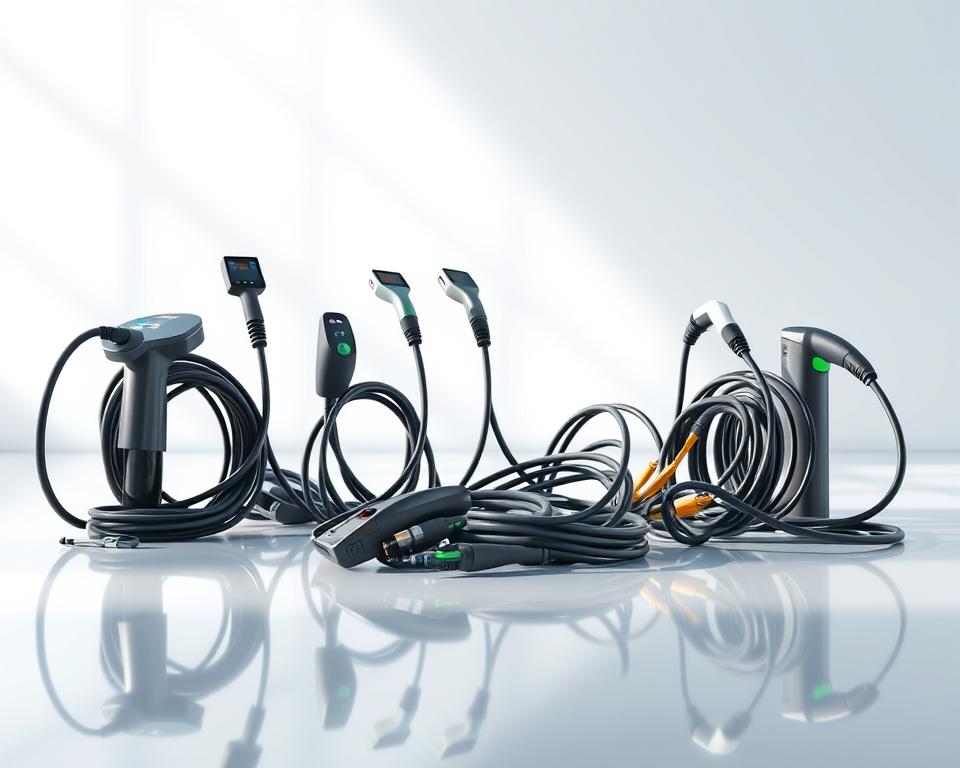
Budget Friendly EV Charging Cables Under 500

Leading EV Charging Cable Manufacturers for Your Electric Vehicle

The EV market is expanding rapidly, with the demand for reliable and efficient charging solutions growing exponentially. As of now, top brands have been at the forefront of this change, providing top-tier charging infrastructure. Southwire, for instance, has been a significant player since 2014, garnering 1000+ five-star reviews and a 75-year legacy in electrical construction.

The rise in electric vehicle adoption creates a requirement for long-lasting, fast, and safe Charger Manufacturers in China. Key suppliers are innovating to address changing requirements, offering solutions that improve the overall charging experience.

Grasping the distinctions between various charging solutions is essential for choosing correctly. High-grade charging infrastructure directly impacts vehicle performance and customer satisfaction.

Primary Conclusions

  • Leading brands provide premium cables that boost durability and security.
  • Growing EV adoption fuels demand for fast, reliable infrastructure.
  • Leading companies innovate to meet the evolving needs of electric vehicle owners.
  • Premium cables enhance both charge rate and vehicle function.
  • Buying premium chargers pays off over time.

EV Charger Manufacturers

Why High-Quality EV Cables Matter

As electric vehicles become increasingly popular, the significance of premium EV charging cables cannot be overstated. The efficiency, safety, and dependability of electric vehicle charging systems rest on the quality of the charging cables used.

Advancements in EV Charging

Electric vehicle charging technology has undergone significant advancements in recent years, with a focus on faster charging speeds and enhanced protections. Modern EV charging cables are designed to meet these evolving needs, featuring superior materials and construction techniques to minimize energy waste and maximize transfer rates.

The Case for Premium Charging Infrastructure

Quality charging cables directly impact the overall performance and safety of EV charging infrastructure. Durable features, such as all-weather performance and flexibility in extreme temperatures, ensure reliable operation across various environments. Additionally, regulatory compliance and following protocols are crucial in ensuring that cables meet rigorous safety requirements.

Key Features Benefits
High-grade build quality Reduced energy waste
Robust durability All-weather reliability
Standards adherence Certified safety
Serviceability Long-term value proposition, reduced waste

Aichie Tech Electronics’ premium cables undergo rigorous testing at The Cable Lab. Choosing maintainable Portable EV Charger, users can save hundreds over a decade by choosing repairs over replacements, reducing waste and protecting the planet.

Top EV Charging Cable Manufacturers in China

A surge of cable makers in China supports the EV boom. These companies are crucial in supporting the expanding electric vehicle (EV) market, providing high-quality automotive cables designed for various charging needs.

Wottz – Pioneers in EV Cables Since 2014

Wottz has been a leading cable manufacturer since 2014. They offer a range of cables that cover Mode 1–4 charging standards, from Mode 1, 2, 3, and DC Fast Charging (Mode 4).

Aichie Tech Electronics’ 75-Year Legacy

Aichie Tech Electronics’ seven-decade legacy informs its premium cable designs. Their products are designed to meet the demands of both domestic and commercial EV charging infrastructure.

Additional Key Cable Suppliers

Specialists in Type 1/Type 2 connectors and environmental-resistant cables are emerging players. These include Type 1 & 2 connector experts, as well as companies developing cables with enhanced flexibility and resistance to environmental factors.

Types of EV Charging Cables Explained

As electric vehicles become increasingly popular, understanding the various types of EV Charging Cable Manufacturers is crucial for optimal charging experiences. Knowing cable types ensures you pick the right charger. The diversity in EV charging infrastructure necessitates a closer look at the different cable types available.

Type 1 vs Type 2 Explained

Type1 and Type2 charging cables are two common standards used for EV charging. Type 1, also known as SAE J1772, is North American standard, while Type 2, or Mennekes, is the European norm. The right cable matches your car and charger. Type 2 cables often support higher charging capacities, making them suitable for faster charging.

Level2 and DC Fast Charging Solutions

Level2 charging cables offer faster charging than Level1, using 240V AC power to deliver up to 19.2 kW of power. DC Fast Charging cables, on the other hand, provide rapid charging by converting AC power to DC within the charging station, delivering rapid fill-ups. These cables are essential for long-distance EV travel, letting EVs charge in minutes.

Portable vs Fixed Cables

Granny chargers plug into home outlets for emergency use. Tethered cables are fixed to charging stations, providing a convenient but less flexible charging solution. The choice comes down to flexibility vs convenience.

Cable length, power rating, and connector type matter most. For instance, portable charging cables range from basic Level1 emergency chargers to more robust Level2 solutions. Vehicle-to-load (V2L) cables represent an emerging category, enabling EVs to power external devices.

  • Flexible granny chargers and L2 units suit various needs.
  • Tethered cables are permanently attached to charging stations, limiting flexibility but eliminating the need for personal cables.
  • Lengths vary from 5 m to 50 m—choose wisely.

Essential EV Cable Characteristics

Premium cables stand out for durability, safety, and performance. These features are vital to safe, efficient charging.

Robustness and Weatherproofing

Cables must withstand rain, sun, and cold. Manufacturers like Wottz and Southwire craft their cables from recyclable materials that adhere to ROHS compliance, ensuring they perform in harsh climates. Their serviceable design facilitates easy maintenance and promotes recycling.

User-Friendly Design

Flexibility and ease of use are also critical factors. High-quality EV charging cables are designed to be flexible, making them easier to handle and maneuver. This flexibility does not compromise their durability, as they are built to withstand regular use.

Certified Safety and Standards

Safety certifications and compliance with international standards are non-negotiable for reputable EV charging cable manufacturers. They ensure their products meet or exceed standards such as IEC62196 for connectors and UL2594 in North America. Independent labs verify safety, toughness, and weatherproofing.

Certification Description Region
IEC62196 Connector safety standards International
UL2594 Standard for electric vehicle supply equipment North America
ROHS Restriction of hazardous substances International

By focusing on these key features, manufacturers can provide EV charging cables that not only meet the highest quality and safety standards but also enhance the overall user experience.

Innovative Technologies from Leading EV Charging Cable Manufacturers

New cable tech is transforming EV charging, with a focus on ultra-fast charging, reliable data transfer, and sustainable compounds.

Liquid Cooling for Rapid EV Charging

Liquid-cooled charging cables are emerging as a key technology for ultra-fast charging, minimizing thermal throttling during high-power sessions.

Signal-Boosting Contact Designs

Hyperboloid contact points improve electrical connection, ensuring reliable and efficient data transfer during the charging process.

Eco-Friendly Cable Compounds

Leading manufacturers are prioritizing sustainability in their cable designs, minimizing ecological footprint with RoHS-compliant, serviceable builds. For instance, companies like Aichie Tech Electronics and Wottz are adopting serviceable design philosophies and RoHS compliance to minimize waste and promote recycling.

The industry’s shift towards sustainability includes the use of TPU jackets, avoidance of hazardous substances, and the development of take-back programs for end-of-life disassembly and material recovery.

Choosing the Perfect EV Cable

Choosing the right EV charging cable is crucial for efficient and safe charging. To make an informed decision, consider several key factors.

Matching Cable to Vehicle

Verify your car’s inlet and cable plug match. Your vehicle’s onboard charger capacity sets the upper limit for AC power.

Length Considerations

Select a cord length based on parking and outlet location. A longer cable provides more flexibility but may be heavier and less manageable.

Power Rating & Charge Rate

Match your cable’s power handling to your vehicle’s capabilities. Standard Level 2 home charging operates at 7.2 kW, but some vehicles support up to 19.2 kW with appropriate electrical service.

By considering these factors, you can select an EV charging cable that meets your needs and enhances your overall charging experience.

Why Choose Premium Charging Solutions

With EV growth unabated, premium cables are essential. Choosing cables from Wottz or Aichie Tech Electronics provides long-term value and reliability. Their serviceable designs allow for component replacement, reducing waste and costs. This approach supports eco-friendly EV use.

By choosing high-quality charging solutions, EV owners can enjoy peace of mind knowing their equipment is certified and compatible with future advancements.

SZ Stranding Line Gearbox Maintenance: Lubrication and Component Inspection

What’s Ahead for Data Transfer: Advances in Fiber Optic Communications

Did you know that one hair-thin fiber can transmit over 100 terabits of data per second? That’s enough to stream 12 million HD movies simultaneously—quite a jump compared to the 1950s, when scientists first harnessed light to send basic signals.

  • Data speeds a hundredfold greater than legacy copper cables
  • No disruption from electrical or radio noise
  • Capacity to support 5G networks and 8K streaming
Feature Copper Wiring Optical Fibers
Data Rate Up to 10 Gbps 100+ Tbps
Distance 100 meters 70+ kilometers
Security Easily tapped Extremely hard to intercept

Optical signals reflect within glass cores via total internal reflection, like a laser ricocheting through a mirrored tunnel. This physics trick prevents signal loss, even over continental distances. As video calls and smart devices multiply, these cables keep networks from collapsing under data weight – Fiber coloring machine.

The Development Path of Fiber Optic Communications

Years of research turned the concept of optical data transmission into a working technology. Scientists in the 1950s found glass fibers can channel light—a concept that reshaped modern connectivity.

8Ce88C7A 8757 4Cc9 8674 31C5Ed87Ec52

Pioneers and Initial Trials

Narinder Singh Kapany made history in 1952 by proving light could travel through bent glass. His work coined the term “fiber optics” and laid the foundation for today’s networks. Together with Harold Hopkins, he created pliable imaging bundles, which became prototypes for data-carrying fibers.

By the 1960s, labs demonstrated practical uses for these strands. Although initial implementations suffered loss, ongoing experiments improved their efficiency. Engineers realized purified glass cores could carry light pulses farther without distortion.

Key Fiber Optic Breakthroughs

In the 1970s, the first commercial deployments revolutionized the industry. Carriers switched from copper to fiber, enhancing call quality and bandwidth. Corning Glass Works achieved a critical breakthrough in 1970—low-loss optical fiber that could transmit signals over 65 kilometers.

Year Achievement Significance
1977 Initial live telephone transmissions Proved real-world reliability
1988 Transatlantic cable TAT-8 Connected continents
1990s Introduction of erbium-doped fiber amplifiers Allowed extensive long-haul connections

Today’s innovations prioritize higher throughput and expandability. Dense wavelength-division multiplexing (DWDM) now lets single strands carry multiple data streams simultaneously. Such progress connects laboratory research to worldwide network infrastructures.

Basic Principles of Fiber Optic Data Transfer

Light travels faster than anything else—so why not use it to send messages?. This straightforward concept underpins contemporary networks. Instead of slow electrons in copper wires, engineers use photons to zip data across continents. Here’s how it works.

Photons vs. Electrons: Why Light Wins

Optical signals transmit data more effectively than electrical currents. Photons:

  • Move at 186,000 miles per second (99.7% light speed)
  • Generate no heat or EMI
  • Support simultaneous multi-wavelength channels
Factor Electrons (Copper) Photons (Glass)
Data Rate Up to 10 Gbps Over 100 Tbps
Noise Susceptibility Affected by power lines Immune
Power Consumption High Low

Total Internal Reflection in Fiber Cores

Light stays trapped in the core—the central glass strand—thanks to total internal reflection. Because the core’s refractive index exceeds that of the cladding. Upon striking the boundary at a critical angle, it reflects internally, traveling long distances.

This design prevents signal loss. Over extensive spans, nearly 95% of photons arrive intact. Paired with precise lasers, it guarantees clear video conferencing and rapid downloads.

Different Types of Fiber Optic Cables

Fibers come in diverse designs. The right cable type depends on how far your data needs to travel and how much information you’re sending. Below are the two primary classifications and their distinct features.

Feature Single-Mode Multi-Mode
Core Size 9 µm 50–62.5 µm
Bandwidth >100 GHz ~35–500 MHz
Maximum Span ~120 mi 1,600 feet
Common Uses Long-haul telephony Data centers

Medical centers deploy single-mode links to move MRI scans across campuses. Schools often pick multi-mode for classroom networks—it handles video streams without breaking budgets. Each cable category maintains connectivity, tailored to specific needs.

Fiber Optic Cable Construction and Key Components

Curious how connectivity persists despite storms? The answer lies in the smart design of modern cables. These high-tech threads use multiple layers to protect data while traveling at light speed.

Core, Cladding, and Coating Layers

At the heart of every cable sits the glass core—thinner than a human hair. This pure glass guides photons via total internal reflection. The cladding layer, with a lower refractive index, reflects stray light back into the core.

An acrylate polymer coating encases the cladding and core. This 250-micron shield prevents scratches and moisture damage. Collectively, these layers create the optical conduit for data.

Armoring and Outer Protection

Real-world durability comes from Kevlar® strands around the coated core. Aramid strands handle pulling forces to avoid fiber breakage. An outer polyethylene jacket completes the package, resisting weather, chemicals, and curious rodents.

Layer Substance Role
Core Pure silica glass Light transmission
Cladding Doped silica Signal containment
Coating Acrylate polymer Physical protection
Outer Sheath Polyethylene Environmental shield

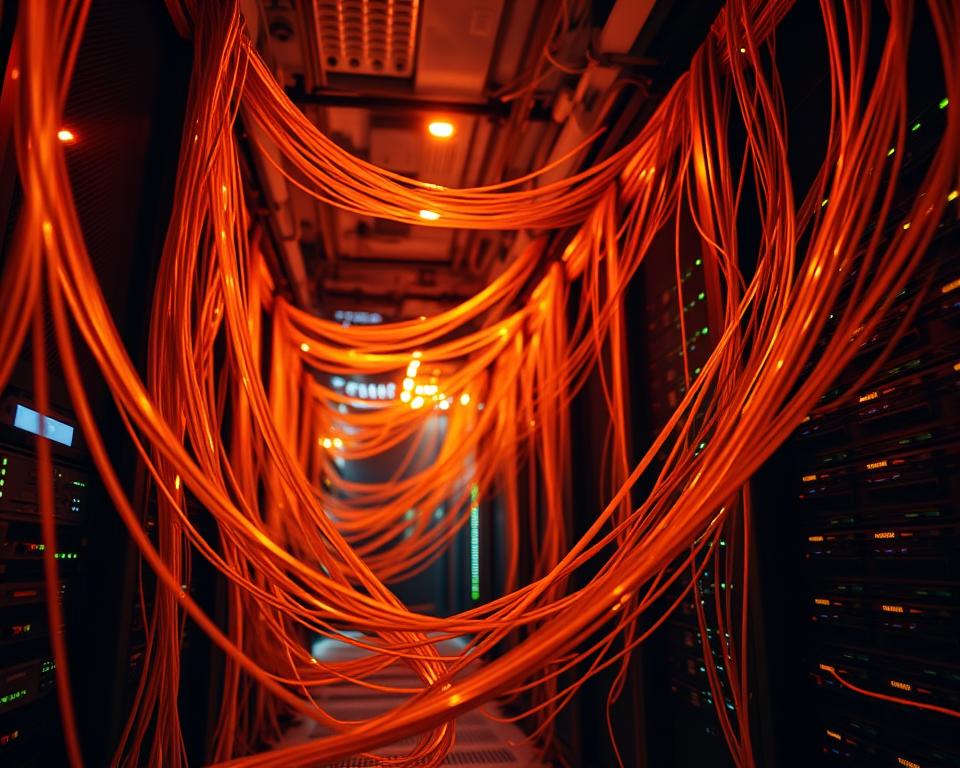
Color coding matters too—orange jackets denote multi-mode cables, while yellow marks single-mode versions. Technicians rely on these hues to differentiate fibers for setup or troubleshooting.

Working Principles Behind Data Transmission

How does information travel at light speed without getting lost It involves converting electrical pulses into controlled optical bursts. Each pulse represents binary code—flashes for 1s, gaps for 0s—creating a rapid-fire Morse code only lasers can read.

Photon-Based Signaling

Lasers emit ~500 million pulses/sec through fiber cores. By using QAM-16, four bits encode per pulse, multiplying throughput – Fibers in metal tube. Such optical signaling is virtually immune to EMI that plagues copper lines.

Managing Dispersion & Attenuation

Two primary issues compromise signal integrity:

  • Chromatic dispersion: Different light colors (wavelengths) arrive at varying speeds.
  • Modal dispersion: Multiple ray paths diverge in multi-mode fibers.

Today’s fibers address these with these solutions:

Remedy Outcome Gain
Doped glass cores Equalizes wavelength speeds 40% less signal spread
DSP units On-the-fly error mitigation >99.999% fidelity

High-end fibers reduce attenuation to ~0.15 dB/km, improving by ~92% over initial versions. Paired with EMI-resistant layers, they preserve signal fidelity worldwide. Consequently, transoceanic calls remain sharp despite severe weather.

Advanced Concepts in Optical Fiber Networking

What keeps your video calls from freezing during a storm The answer lies in specialized connectors and precision installation methods that form the backbone of modern networks. Such gear guarantees uninterrupted data transfer regionally and globally.

Fiber Termination & Splicing Methods

Network reliability starts with proper connections. SC connectors offer tool-less insertion; LC connectors compress for high-density environments. MPO/MTP designs handle multiple strands at once—perfect for data centers moving massive files.

Splicing primarily uses two approaches:

  • Fusion splicing: Joins fiber ends by fusing, achieving minimal insertion loss.
  • Mechanical splicing: Aligns fibers with precision sleeves for quick repairs.
Connector Best For Insertion Loss
SC Enterprise networks ~0.25 dB
LC High-density devices 0.20 dB
MPO Data center interconnects 0.35 dB

Modern Network Integration

Today’s architectures demand flexible installations. Micro-ducts let technicians blow cables through underground pipes, while armored designs withstand harsh outdoor conditions. Municipal implementations route fiber to traffic systems and surveillance, enabling intelligent networks.

Major telecom providers now deploy hybrid cables combining power lines and optical strands. Such designs feed 5G small cells and IoT sensors alike, showcasing agile network evolution.

High-Speed Data Transmission and Bandwidth Benefits

Imagine data as water in pipes: larger pipes yield greater flow. This bandwidth principle underlies the shift to fiber optics. Where copper struggles like a garden hose, advanced cables act as firehoses, handling thousands of HD streams simultaneously.

  • Photons moving at ~186,000 mi/s
  • Multiple data streams via wavelength multiplexing
  • FEC slashes retransmissions by ~80%
Time Period Max Speed Cost per GB
1980s ~45 Mbps Approximately \$1,200
2000s 10 Gbps ~\$0.12
2020s ~178 Tbps ~\$0.0004

Bandwidth directly impacts what we can do online. Video calls require ~5 Mbps each; VR needs ~50 Mbps. As NEC’s 2023 report shows, networks using glass cables support 40x more users than copper alternatives at half the energy cost.

“Every dollar invested in high-capacity networks yields $3.80 in economic growth through improved productivity.”| “Each \$1 poured into high-bandwidth infrastructure returns \$3.80 in productivity gains.”

— Tech Market Analytics, 2023

Performance improvements also slash operational costs. Signals travel 60 miles without repeaters versus copper’s 3,000-foot limit. This efficiency enables 8K video streaming, real-time AI processing, and seamless cloud backups—all while keeping your monthly bill under $100.

Mitigating Noise & Attenuation

Ever tried making a call during a thunderstorm only to hear static Copper wiring falters when EMI spikes. Optical fibers shrug off such noise. By leveraging photons rather than electrons, they eliminate interference from electricity or RF sources.

Inherent EMI Immunity

While copper acts as an antenna, fiber is non-conductive. This means they ignore disruptive signals that plague copper networks. Industrial trials in 2023 recorded ~92% fewer errors with fiber vs. legacy copper – FTTH cable production line.

Mitigation of loss relies on:

  • High-purity cores minimize photon scattering
  • Accurate laser coupling decreases insertion loss
  • Hydrophobic layers block water infiltration
Metric CM Fiber
Interference Risk High None
Attenuation per Mile 3 dB ~0.2 dB/mi
Maintenance Needs ~Monthly upkeep ~Yearly reviews

“Our factory’s error rates dropped 80% after switching to light-based networks—no more machine downtime from radio interference.”| “After switching to fiber, error rates fell by 80%, eliminating downtime from RF noise.”

— Manufacturing Weekly Case Study

These cables thrive where others fail. Subsea installations withstand saltwater corrosion, while desert networks endure sandstorms without signal degradation. Boasting ~99.995% reliability, they power essential infrastructures globally.

Fiber’s Role in Telecom & Internet Services

What delivers instant streaming from overseas servers? Fiber networks serve as the neural pathways of today’s Internet. They enable streaming, financial transactions, and more, using light to span oceans and landmasses.

Long-Distance & Metropolitan Fiber Deployment

Undersea fibers run ~750,000 mi, handling ~99% of intercontinental data. In cities, metro networks link cell towers and offices using hair-thin strands. Optical transmitters modulate light; receivers demodulate at endpoints.

Feature Copper Infrastructure Fiber Infrastructure
Throughput 1 Gbps 100 Tbps
Latency 5 ms/km 0.005 ms/km
Uptime ~99.9% ~99.995%

Data Center & Cable Television Uses

Within data centers, fibers enable rack-to-rack transfers, shifting petabytes each day. Cable networks use hybrid optical/coax infrastructure to stream 4K. After Verizon’s 2023 fiber rollout, buffering issues dropped by ~73%.

Three economic benefits drive adoption:

  • 60% lower maintenance costs than copper
  • Scalability to handle 5G demands
  • Energy consumption ~40% less per data volume

From Manhattan’s financial district to Pacific submarine routes, these communication systems prove that speed and reliability can coexist. As one engineer noted: “You can’t beat light for moving mountains of data.”

Emerging Technologies in Fiber-Optic Applications

Imagine networks accommodating 8 billion simultaneous video streams. That’s the promise of next-gen innovations reshaping how we move information. Cutting-edge devices and smarter signal methods are pushing networks to new limits.

Next-Gen Transmitters & Detectors

Modern lasers now fire 200 wavelengths simultaneously—up from just 40 a decade ago. They deliver ~5× the output at ~30% reduced consumption. Combined with graphene-based photoreceivers, they detect even minimal photon levels.

Major innovations encompass:

  • Narrow-linewidth lasers reducing noise by 90%
  • PICs consolidate functions, shrinking component footprints
  • AI-driven calibration maintaining peak performance

Coherent Optics & Multiplexing

Coherent optics modulate both phase and amplitude to encode information. Such techniques increase throughput ~16× over basic on-off keying. Coupled with WDM, fibers can transport over 800 channels.

Method Channels Capacity
DWDM ~160 ~80 Tbps
OFDM ~512 ~120 Tbps
SDM Multi-core ~1 Pbps*

*Experimental (NTT, 2023)

These systems integrate smoothly with existing infrastructure. In 2024, Verizon’s coherent deployment doubled bandwidth on existing fiber routes. As one engineer noted: “We’re teaching old cables new tricks—the best is yet to come.”

Worldwide Fiber Standards & Guidelines

Ever wondered how your video call stays crystal clear across continents Universal protocols guarantee seamless interoperability across diverse systems. Without these guidelines, networks would struggle with compatibility issues and performance gaps.

Standard Scope Impact
ITU G.652 Single-mode fiber Enables 100Gbps+ speeds
IEC 60793-2-50 Mechanical reliability Ensures 20-year lifespans
ITU G.654 Undersea fiber Enhances marine durability

Testing & Quality Benchmarks

Rigorous validation ensures reliable operations. Primary metrics: attenuation (<0.25 dB/km) and tensile rating (>50 N). Manufacturers run 200+ checks before shipping products, from temperature resistance to bend tolerance.

“Our compliance with IEC 61300-3-35 reduced installation errors by 65% last year.”| “Adhering to IEC 61300-3-35 led to a 65% drop in deployment mistakes.”

— Network Solutions Quarterly Report

Certified parts and precise specs avert expensive rework. Technicians rely on uniform color schemes and termination practices to link heterogenous gear flawlessly. This harmony keeps global data flowing without hiccups.

Real-World Fiber Deployment Examples

How do cities handle millions of simultaneous video streams without crashing Real-world deployments show how smart planning and advanced cables keep our digital world running smoothly. Let’s explore two groundbreaking projects that reshaped global connectivity.

City Fiber Rollouts & Metropolitan Backbones

NYC’s Metro Fiber initiative addressed slow copper infrastructure, which hindered business connectivity by ~40%. Engineers installed 800 miles of micro-trenched cables under sidewalks, avoiding subway tunnels and gas lines. Outcomes: Latency fell from ~14 ms to ~2 ms; throughput increased by ~600%.

Challenge Solution Outcome
Subsoil crowding 3D mapping for route optimization 92% faster installation
EMI challenges Armored MC fiber ~99.99% reliability
Funding limits PPP funding model 30% cost reduction

Underwater & Cross-Ocean Deployment

The MAREA cable—stretching 4,000 miles between Virginia and Spain—handles 160 Tbps across eight fiber pairs. Teams contended with ~10,000 ft depths and marine hazards, deploying ROVs to trench cables into ocean floor. Costing \$160M, it transmits ~55% of transatlantic data.

“Subsea systems require 200+ design revisions before deployment. Every meter matters when you’re laying cable across tectonic plates.”| “Over 200 design iterations are typical for undersea cables. Small changes hugely impact viability across plates.”

— Global Connectivity Report 2023

Differences by deployment scenario:

  • Urban projects use bend-resistant cables for tight corners
  • Marine deployments need titanium-armored jackets
  • Remote installations leverage solar-powered repeaters

Both approaches prove that strategic design and durable materials can transform how we move data. Spanning city high-rises to sea depths, fiber underpins today’s digital existence.

Economic Impact and Scalability of Fiber Networks

What fuels today’s streaming surge and telecommuting trend? The answer lies in networks that combine upfront investment with long-term savings. While initial deployment costs can reach \$60,000 per mile, these systems deliver unmatched value over decades of service.

Smart Spending for Future Growth

Upgrading to advanced networks cuts operational costs by 40% compared to copper systems. Fewer repairs are needed—no more corrosion issues or EMI troubleshooting. A 2024 study showed:

Cost Factor Copper-Based Modern Networks
Deployment \$45/meter ~\$28/m
Power Consumption ~5 W/device ~1.2 W/device
Repairs ~12 annually 2/year

Worldwide spending reflects this transition. Major carriers will invest ~\$150B by 2027 to grow fiber footprints. Locale upgrades hit ~300% ROI in 5 years via boosted efficiency and minimized outages.

Navigating Deployment Hurdles

Despite clear benefits, cities face three key challenges:

  • Permitting delays adding 18 months to timelines
  • Labor shortages in specialized installation crews
  • Community pushback against trenching

“Our Phoenix deployment took 22 months instead of 14 due to permit bottlenecks. Still, the network boosted local GDP by \$380 million annually.”| “Phoenix’s build required ~22 months, not 14, over permit delays—but delivered ~\$380M/year in GDP uplift.”

— Western Regional Infrastructure Report

Novel remedies appear. Micro-trenches cut surface impact by ~80%; PPP models distribute funding risks. These approaches help communities harness the power of scalable, future-ready systems without breaking budgets.

Innovations and Future Prospects in Data Transmission

Data highways are getting a turbocharged makeover. Researchers now push boundaries with materials thinner than spider silk and signaling methods that outpace traditional designs. Such progress aims to reduce latency and accommodate future data surges.

Upcoming Fiber Innovations

MIT’s 2024 experiments suggest hollow-core fibers (air-filled) may cut latency ~30%. These tubes guide light through vacuum-like channels, reducing signal drag. Parallel multi-core fibers embed seven channels in one sheath, boosting throughput ~4×.

Feature Current Tech Future Projection
Throughput ~100 Tbps ~1.2 Pbps
Range ~70 km 150 km
Power Demand ~0.5 W/device ~0.15 W/device

New multiplexing schemes squeeze 400 wavelengths into single strands—up from 160 today. This spectral densification enables 8K VR without congestion.

Convergence with 5G/6G Networks

Future 6G deployments depend on high-capacity fiber rooftails for mmWave support. Trials in Dallas show hybrid systems delivering 10 Gbps wireless speeds when paired with high-capacity backbones.

  • 5G small cells need fiber links every 500 feet
  • Satellite-ground stations require low-latency connections
  • Smart factories use real-time data flows for robotic precision

Nokia’s 2023 report says advanced fiber cuts 5G round-trip delay by ~82%. In one expert’s words: “Wireless depends on wired guts—the quicker the spine, the clearer the signals.”

Conclusion

The invisible threads connecting our digital world keep getting stronger. Material science and engineering leaps have moved us from copper constraints to optical velocity. Today’s networks prove faster isn’t just better—it’s essential for streaming, surgeries, and stock markets alike.

Today’s networks succeed due to clever engineering. Polymer coatings defend fragile cores; international specs guarantee interoperability. These innovations slash energy use by 40% compared to older methods, making high-speed access both sustainable and scalable.

Challenges remain, like installation costs and public awareness. Still, ROI is strong—each \$1 spent returns ~\$4 in economic output. As 5G expands and AI demands real-time data, reliable infrastructure becomes non-negotiable.

Looking ahead, researchers aim to push boundaries further. Hollow cores and advanced wavelength methods may render current rates outdated. Undoubtedly, information exchange will advance further, fueled by our relentless drive for faster, broader, and more intelligent connectivity.